
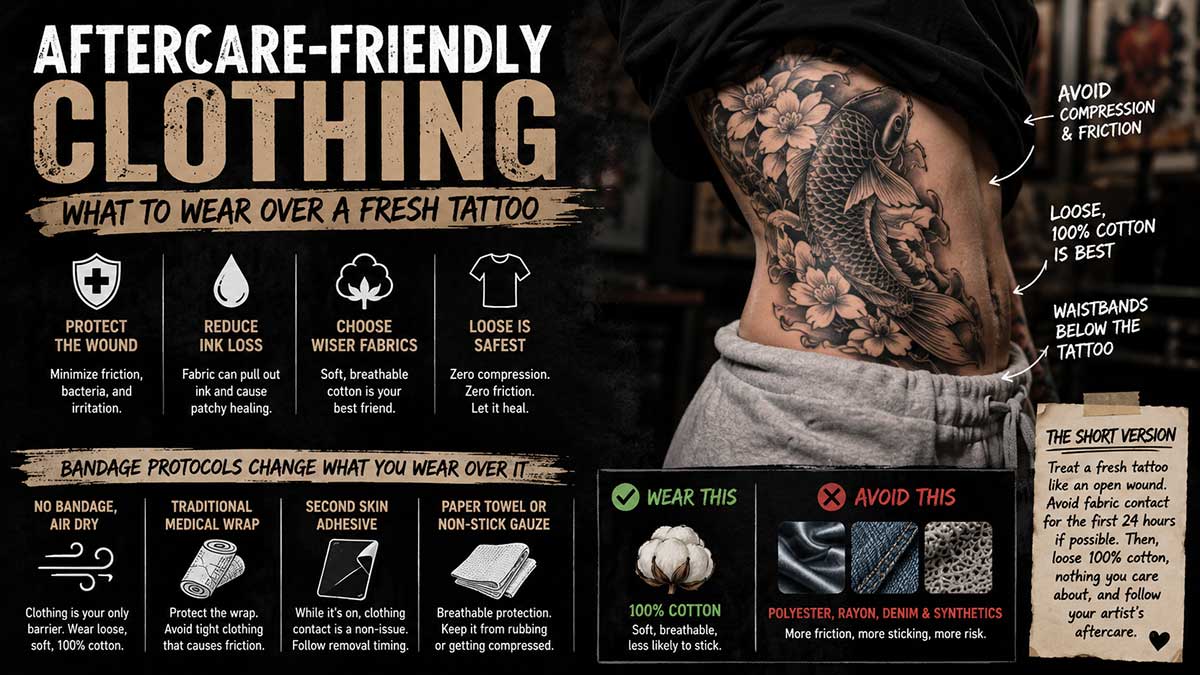
Aftercare-Friendly Clothing — What to Wear Over a Fresh Tattoo
Your tattoo is a wound. Your choices about what covers it in the next couple of days are medically-driven, not fashion driven. There are many variables involved with how well a tattoo heals, and they include:
1. The type of material you choose to cover it.
2. How well the garment fits.
3. How your artist wraps the work.
Why contact with fabric on a new tattoo is a bad idea.
Blood and plasma leak from your skin during the hours following a tattoo session as part of the healing process. Plasma dries, and then it forms a weak bond between the wound surface and anything in contact with it — such as the fibers of clothing.
The primary issue arises when clothing is removed. The dried plasma does not simply peel away cleanly; it peels away with the fibers. Thus, the dried plasma actually binds clothing fibers to the wound itself, pulling them along when removing the garment. One of the most prevalent reasons for uneven healing, and lost ink, have absolutely nothing to do with how your artist works.
The higher the risk is for damage caused by this phenomenon, the closer together the hours are post-tattoo session. The risk is at its greatest within the first twenty-four hours post-surgery and diminishes as the skin starts to heal and closes. Most of the leaking stops by day 3-4 and the risk dramatically declines.
Another issue - ink bleeds into fabric.
The ink used in tattoos remains very near the surface of the skin until the skin is fully healed. For this reason, during this timeframe (usually 2-3 days), ink can bleed outward onto any clothing item placed upon it. Two consequences arise from this bleeding:
your clothing may absorb some of the ink; and theoretically, dye from clothing items made of heavy pigment materials may migrate onto the surface of a healing tattoo.
Do not place anything you value over a freshly done tattoo for several days. This rule particularly applies to garments that are white or light-colored when placing them over highly saturated black & gray or colorful tattoos.
The impact of bandaging procedures on your clothing choices.
How your artist decides to dress your new tattoo affects your options greatly.
Air Drying
Some artists feel that allowing a new tattoo to "breathe" without any covering is better for healing. If so, there is no other barrier than your clothing between your newly created ink and everything else. Choose loosely-fitting, 100% cotton garments over your tattoo site. Do not select any tight-fitting articles of clothing, nor those containing man-made fibers. Also avoid elasticated edges resting directly on the site of your new tattoo.
Traditional Medical Wrap
A plastic or non-stick dressing covered by medical tape provides a physical barrier between your new tattoo and external elements. Although clothing resting over a properly-wrapped tattoo presents fewer issues than previously mentioned; however, fit is still important because tight-fitting articles will compress against the wrap creating friction which may disrupt it.
Adhesive Second Skin Film
An almost invisible film applied directly to your new tattoo serves as a protective second layer of skin. As long as this film remains intact, contact with clothing is minimalized. Upon removal (usually 3 – 7 days depending on your artist’s direction); your skin has progressed further along in the healing process making clothing-related risks lower.
Gauze/Paper Towel
Simple breathable methods employed by some artists for smaller areas. Like traditional wrapping; consider protecting the bandage from compression and friction from tightly-fitting clothing over your tattoo.

De Ryan Smith